
Structure you don't have to hold in your head
ADHD mornings rarely fail for lack of a plan — they fail because the plan lives in working memory while everything else competes for it. Rouse moves the plan outside your head: timed steps, a voice that announces what's next, and a countdown that's always visible.
Get Rouse FreeExternalize the executive function
The pattern that works for many people with ADHD is simple to state and hard to do alone: make time audible and visible, and make the next step someone else's job to remember. That's exactly what a Rouse routine does:
- Voice prompts announce every transition — "Get dressed. Eight minutes." — so you never have to remember what comes next or notice that it's time to switch.
- Per-step countdowns counter time blindness — each task has its own ticking timer, with optional remaining-time announcements and a spoken 3-2-1 before each switch.
- Lock Screen progress — a Live Activity shows the current step and progress ring at a glance, so checking the time doesn't require unlocking into distraction.
- One tap to start — no setup ritual every morning. The routine is built once; mornings are just "press play."
First, actually wake up
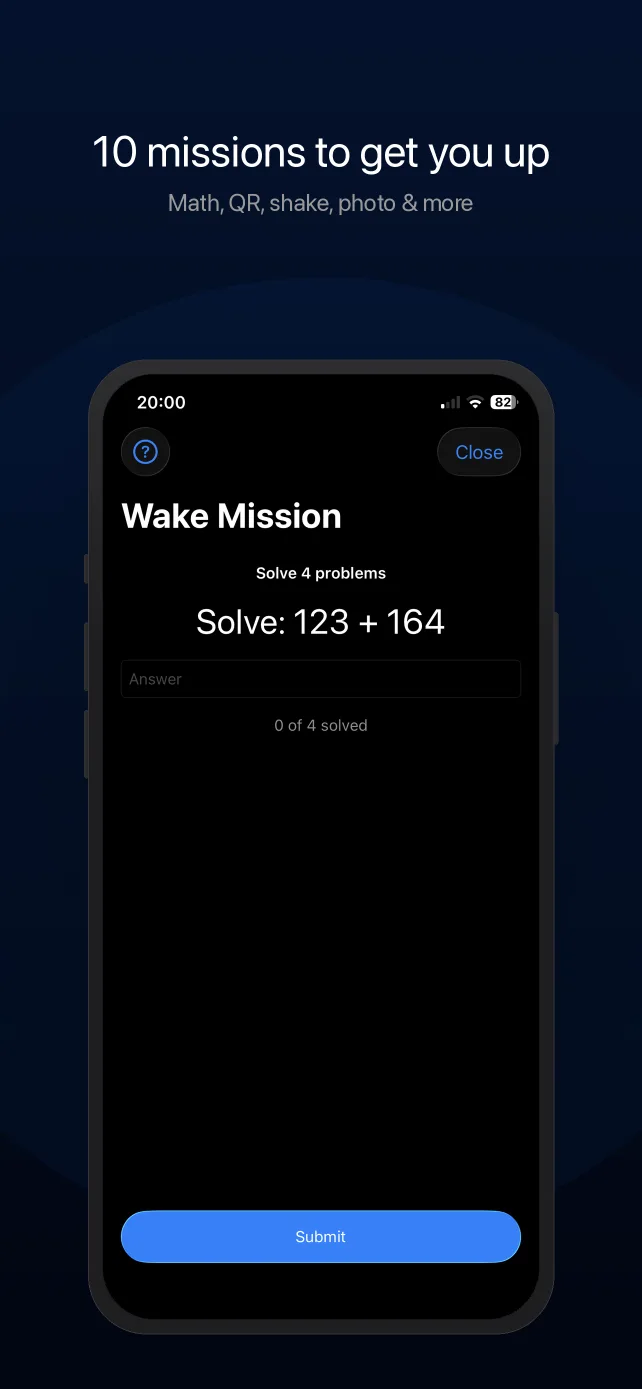
None of it matters if the alarm gets dismissed half-asleep. Rouse alarms fire through Silent Mode, DND, and Focus — and you can attach wake-up missions that engage your brain before the alarm stops: solve a math problem, shake the phone, walk 20 steps, or scan a QR code you've taped to the bathroom mirror. Chain several together for the full gauntlet.
A Wake-Up Check follows up a few minutes after dismissal; if you don't respond, it nudges again. The snooze degradation option makes each snooze shorter than the last.
Built-in starting points
The routine library includes 22 presets — structured mornings (Quick Start, Parent Rush, Student Focus), Pomodoro-style focus blocks for work sessions, evening wind-downs, and after-school sequences for kids. Start from one and tune the durations to reality rather than aspiration; steps can be timed in minutes or seconds.
Streaks and a daily morning score give the consistency loop a dopamine hook — 22 achievement badges included. And "days since" count-up countdowns with streak tracking work for any habit you're building or breaking.
Common questions
How can a routine app help with ADHD mornings?
Many people with ADHD find that externalizing structure helps: instead of holding a plan in your head, a routine app times each task and announces transitions out loud. Rouse runs your morning as a sequence of timed steps with hands-free voice prompts, a visible per-step countdown, and Lock Screen progress — reducing the need to remember what's next or estimate how long things take.
What helps with time blindness?
Each step in a Rouse routine has its own ticking countdown, and voice coaching can announce remaining time at intervals you choose, plus a 3-2-1 before each transition. Time stays audible and visible instead of silently slipping.
What if I dismiss the alarm and go back to sleep?
Rouse alarms fire through Silent Mode and DND (built on Apple's AlarmKit), and you can add wake-up missions — math problems, shaking the phone, scanning a QR code across the room, or walking steps — chained in sequence. A Wake-Up Check can follow up after dismissal to confirm you're actually up.
Is Rouse a medical or therapeutic product?
No. Rouse is a general-purpose alarm and routine app. It is not a medical device and doesn't diagnose or treat ADHD or any condition — it provides timers, voice prompts, and structure tools that many people, including those with ADHD, find useful.
Try it on tomorrow morning
One routine with full voice coaching (up to 5 steps), Silent Mode-proof alarms, Math & Shake missions, and timers — free, no account required.
Download on the App StoreRequires iOS 26 or later. Rouse is a general-purpose alarm & routine app — not a medical device, and not a diagnosis or treatment for ADHD or any condition.